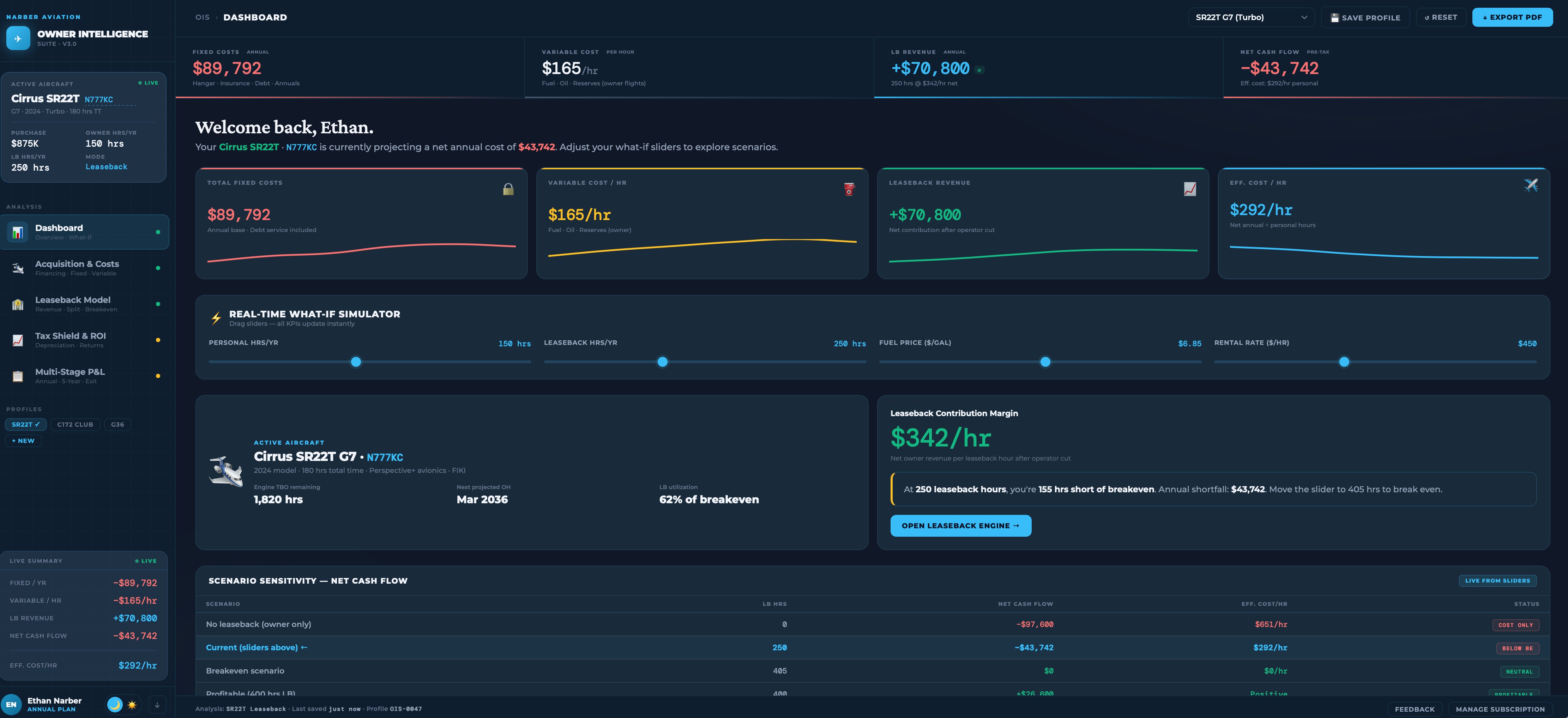
Total Fixed Costs
$0
Annual base fixed + debt service
Owner Var. Cost / Hr
$0
Fuel + Reserves (Personal flights)
Gross Revenue
$0
Total Leaseback Income
Final Net Cash Flow
$0
Pre-Tax (After all personal flights)
1 Acquisition & Financing
Est. Monthly Payment:
*Excludes bank fees, sales tax, & origination.
$0
2 Base Fixed Annual Costs
Total Base Fixed Costs:
$0 / yr
3 Personal Usage & Fuel
How many hours will you fly for personal/business use?
TBO & Engine Reserves Auto-Calculator
Engine Res.
$0/hr
Prop Res.
$0/hr
Manual entry for general wear & tear
Owner Total Cost Profile Base vs. Leaseback
Total Yearly Cost
$0
Fixed + Personal Var
Cost Per Hour
$0/hr
No Leaseback factored
Effective Net Cost Per Hour (WITH LEASEBACK)
$0/hr
Your final net cash flow divided by your personal flight hours.
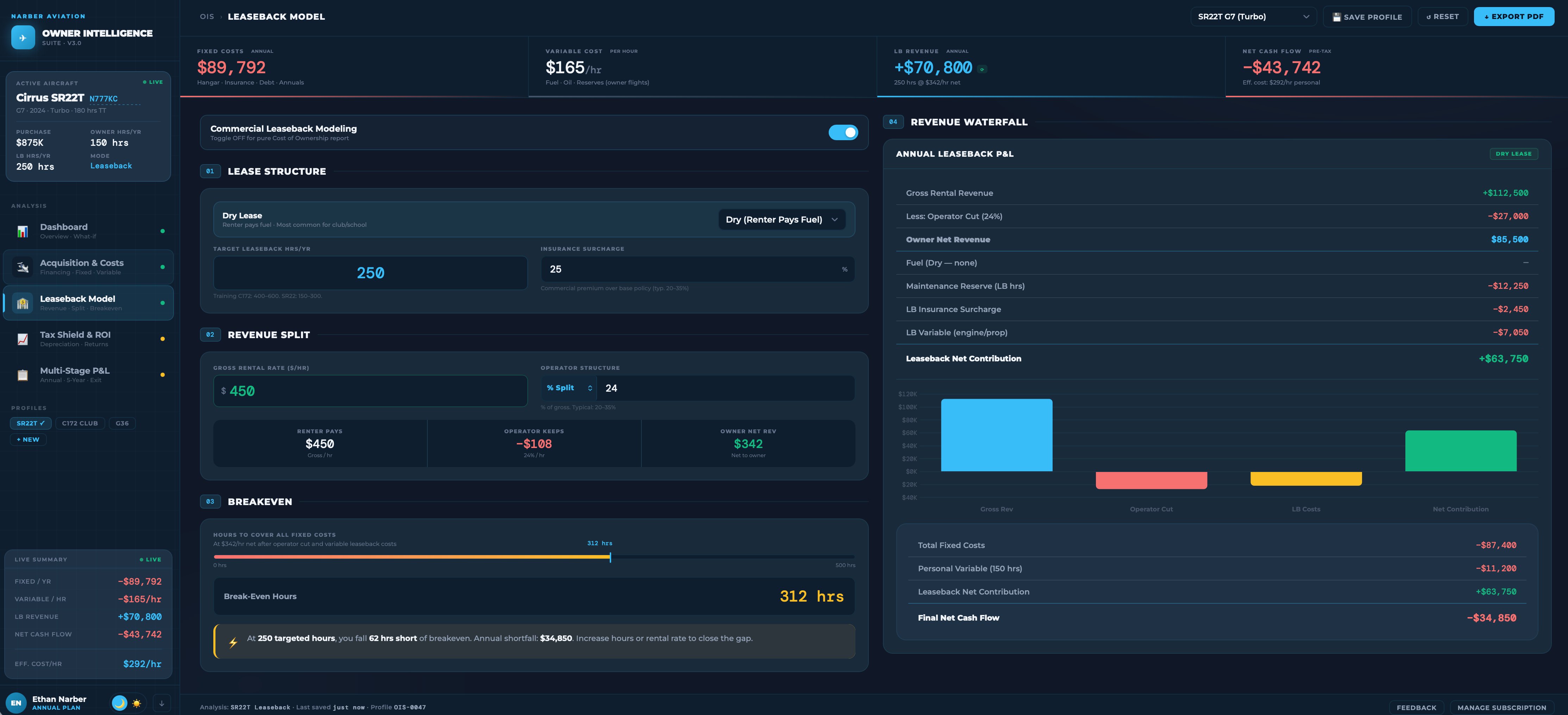
Enable Commercial Leaseback Modeling
Toggle ON to model revenue. Toggle OFF for a pure Cost of Ownership report.
Leaseback Revenue Model
Determine how Operator/Club rentals offset your ownership costs.
Lease Structure
Who pays for fuel during leaseback flights?
Leaseback Volume & Insurance
Increase over base insurance for commercial use.
Revenue Split Parameters
Break-Even Calculator
At your average net rate of $0/hr minus your variable leaseback cost of $0/hr, your leaseback contribution margin is $0/hr.
Hourly Revenue Breakdown
Customer Pays
$0
Operator Keeps
$0
Owner Net Rev
$0
Leaseback Hourly Unit Economics
*Assumes Dry Lease: Renter pays fuel. Owner pays Operator cut and Maintenance Reserves.
Tax Shield & Return on Investment
Estimate tax savings and your Cash-on-Cash ROI.
Disclaimer: This is a highly simplified model. Section 179 and Bonus Depreciation rules are complex and require "ordinary income" or passive income offsets. Always consult an aviation CPA.
Initial Cash Investment
$0
Down payment + Sales Tax
Operating Cash-on-Cash
0%
Leaseback NOI / Initial Investment
Total ROI (With Tax Shield)
0%
(NOI + Tax Savings) / Investment
| Depreciable Basis | $0 |
| Estimated Year 1 Deductions | $0 |
| Est. Year 1 Tax Savings | $0 |
5-Year Equity & Exit Strategy
Estimate your net cash position if you sell the aircraft after 60 months.
Est. Asset Value (Yr 5)
$0
Remaining Loan Balance
$0
After 60 monthly payments
Estimated Net Cash at Sale
$0
Asset Value minus Debt
Reality Check Scenario Stress Tester
Simulate weather, maintenance downtime, or low student volume.
Unexpected surprise bills (e.g., blown cylinder).
Overrides Cash Flow Scenario Toggles
Use these toggles to quickly model different "real-world" cash flow strategies across the entire application.
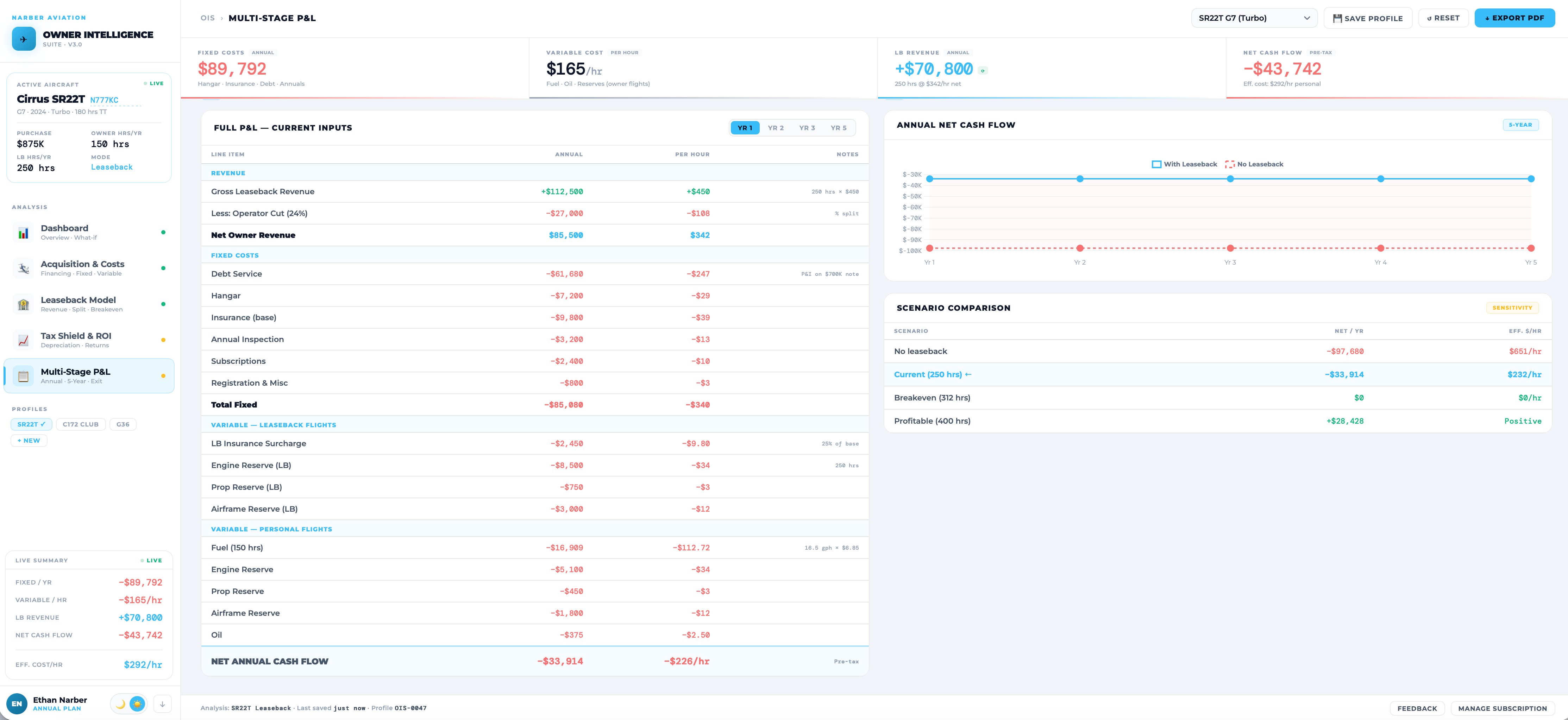
Year 1 Profit & Loss
Pre-Tax Operational| Stage 1: Commercial / Leaseback Operations | |
| Gross Leaseback Revenue | |
| Less: Operator Cut / Mgmt Fee | |
| Net Leaseback Revenue | |
| Less: LB Variable Costs | |
| Leaseback Contribution Margin | |
| Fixed Expenses (Annual Base) | |
| Debt Service (P&I) | |
| Insurance, Hangar, Annual, Cal. Reserves, Misc | |
| Unplanned Maintenance Shock | |
| Net Operating Income | |
| Stage 2: Owner Personal Operations | |
| Owner Personal Variable Costs | |
| Final Net Cash Flow | |
Total Financial Flow
Note on Methodology: This P&L separates your leaseback operations from your personal operations. This helps identify if the leaseback is truly covering your fixed costs (NOI) before factoring in your personal recreational flying costs.
Legal & Regulatory Compliance Notice
1. FAA Regulations (Part 91 vs. Part 135): This financial model assumes operations under a valid FAR Part 91 Lease. Under a true dry lease, the lessee assumes operational control and provides their own crew and fuel. Improperly structuring a leaseback where the owner provides both the aircraft and the crew may be construed by the FAA as an illegal commercial charter operation. Always consult with a qualified aviation attorney to draft compliant lease agreements.
2. Tax Considerations: Computations regarding Bonus Depreciation, MACRS, and Section 179 are highly simplified estimates based on current standard IRS codes, which are subject to phase-outs and changes. Claiming these deductions typically requires the owner to "materially participate" in the business or have sufficient qualifying income to offset. Passive loss rules may severely limit deductibility. Narber Aviation LLC does not provide tax advice. Consult an aviation CPA.
3. Financial Projections: All outputs generated by this tool are hypothetical projections intended for educational and modeling purposes only. Real-world costs (especially insurance and maintenance overhauls) fluctuate wildly based on pilot experience, geographic location, and supply chain constraints. Narber Aviation LLC disclaims all liability for any financial decisions made based on this analysis.